Fruit Leather
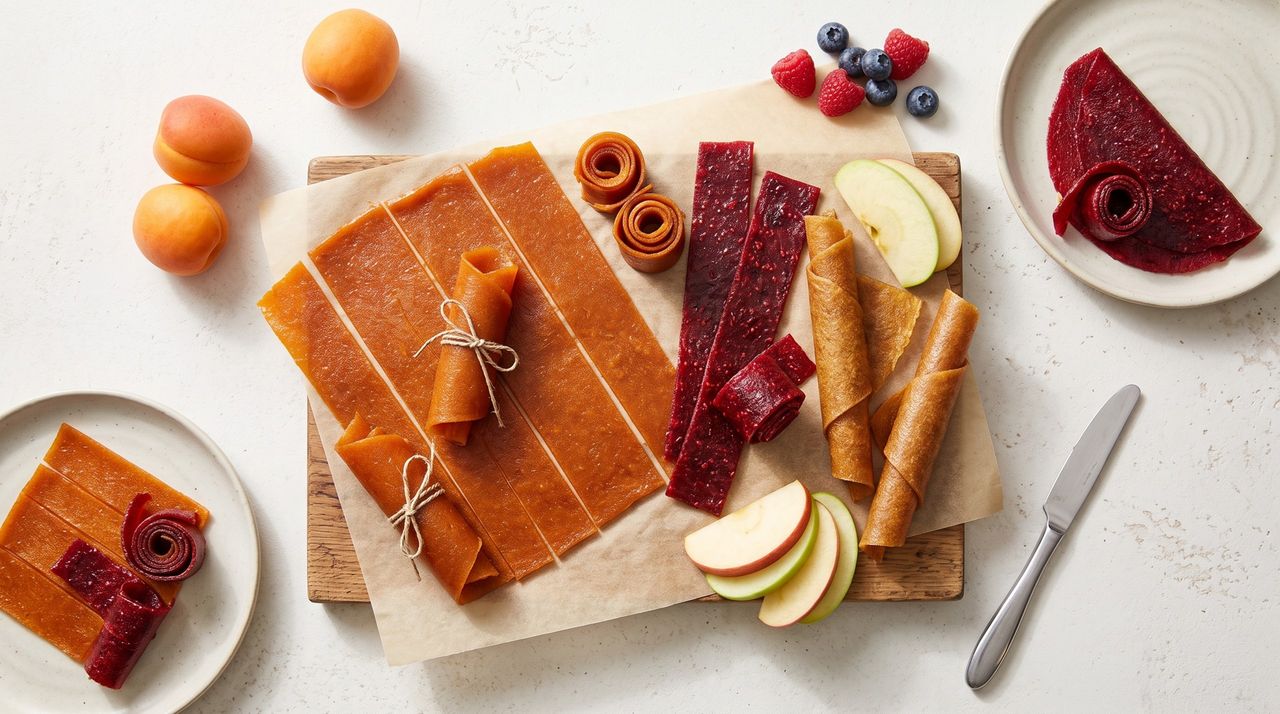
Homemade chewy fruit leather made by slowly drying a smooth fruit purée in the oven — great for any stone fruit, berries, or apples.
- 560
- min
- 10
- servings
- ~60
- kcal per serving
- Difficulty:
- Easy
01Method
- 1
Rinse the fruit thoroughly. Remove pits from stone fruit, peel and core apples or pears, and de-stem grapes. Chop everything into rough pieces. Taste the fruit to gauge its sweetness before continuing.
- 2
Transfer the chopped fruit to a large saucepan and add a small amount of water — about half a cup per four cups of fruit. Bring to a gentle simmer, cover, and cook over low heat for 10 to 15 minutes until the fruit is completely soft. Remove the lid, stir, and mash the fruit with a potato masher.
- 3
Taste the mashed fruit and adjust flavor as needed. Stir in sugar one tablespoon at a time until the desired sweetness is reached. Add lemon juice one teaspoon at a time to brighten the flavor. If desired, incorporate a pinch or two of cinnamon, nutmeg, or other spices. Continue simmering and stirring until any sugar has fully dissolved and the mixture has thickened, about 5 to 10 minutes more.
- 4
Pass the cooked fruit through a food mill or fine-mesh strainer, or blend it thoroughly in a blender or food processor until completely smooth. Taste once more and make any final adjustments to sweetness or seasoning.
- 5
Line a rimmed baking sheet with sturdy, microwave-safe plastic wrap. Pour the purée evenly onto the sheet to a thickness of roughly 1/8 to 1/4 inch.
- 6
Preheat the oven to 140°F. Place the baking sheet inside, ensuring the plastic wrap does not touch the oven walls or racks and is not folded over the purée. Use the convection setting if available to speed drying. Allow the purée to dry in the oven until it is no longer tacky to the touch — typically 8 to 12 hours, often left overnight.
- 7
Once fully dried, peel the fruit leather away from the plastic wrap. Roll it up in its wrap, place it in an airtight container, and store in the refrigerator or freezer.
Allergens
None of the 14 tracked allergens according to the catalog's ingredient data.
Allergen information is derived from ingredients and is indicative. Always check the label of the actual product.